How Synthite Runs Task Management as a Conversation, with SIA, Built on Byteflow
SIA, short for Synthite Intelligent Assistance, is Synthite Industries' internal AI teammate, built on Byteflow. Across 16 branches and 700+ employees, people log work by simply talking to it, and managers get real visibility without chasing a single update.
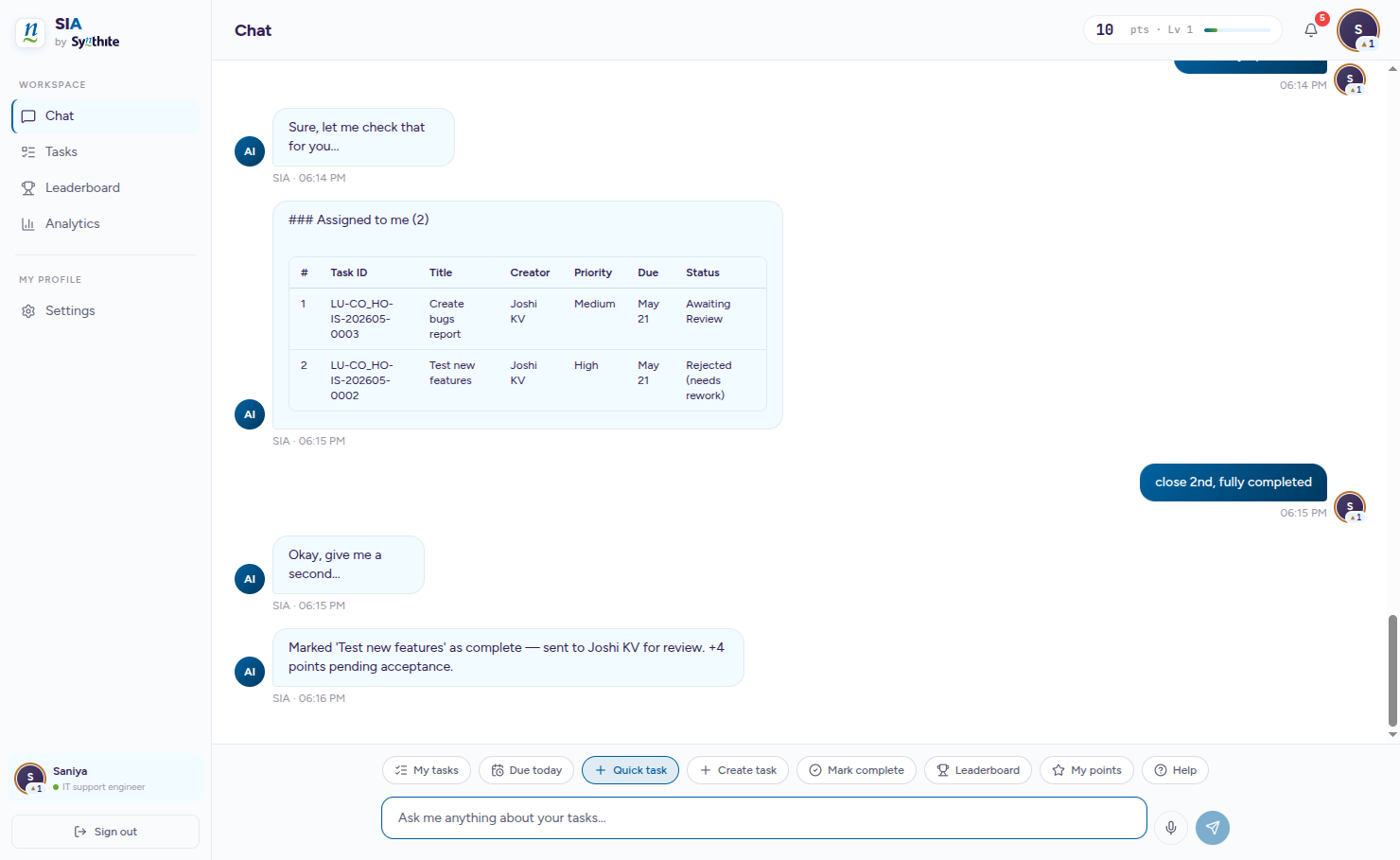
The home screen is a conversation, not a form.
The result
As Synthite grew across branches and departments, simply knowing what everyone was doing became a part-time job. SIA, an AI task teammate built on Byteflow, replaced the stale trackers with a conversation. Employees describe their work in plain language; SIA logs it, and built-in gamification, points and leaderboards for completed work, keeps people motivated while the whole organisation stays visible in real time.
Every growing company hits the same wall. You add more branches, more departments, more people, and suddenly the simple act of knowing what everyone is doing becomes a part-time job. Spreadsheets bloat. Trackers go stale. Managers chase updates. Employees forget to log things, then forget what they forgot. The work gets done, but the visibility and the rhythm of a team that knows itself quietly disappears.
That is the problem Synthite Industries set out to solve, and they solved it by building SIA on Byteflow.
A task manager that talks back
SIA looks deceptively simple. Open it, and you see a chat window. No forms, no dropdowns, no "Project → Sub-project → Sprint → Epic" hierarchy to navigate before you can say what is on your mind. You just type the way you would message a colleague, "I closed the Kochi vendor onboarding today, took longer than expected because of a GST mismatch", and SIA understands.
The Byteflow-powered AI agent behind SIA logs the task, awards the points, updates your leaderboard standing, notes the friction with the vendor for next time, and sends any follow-up email needed. You did not fill out a form. You had a conversation, and the system did the bureaucracy.
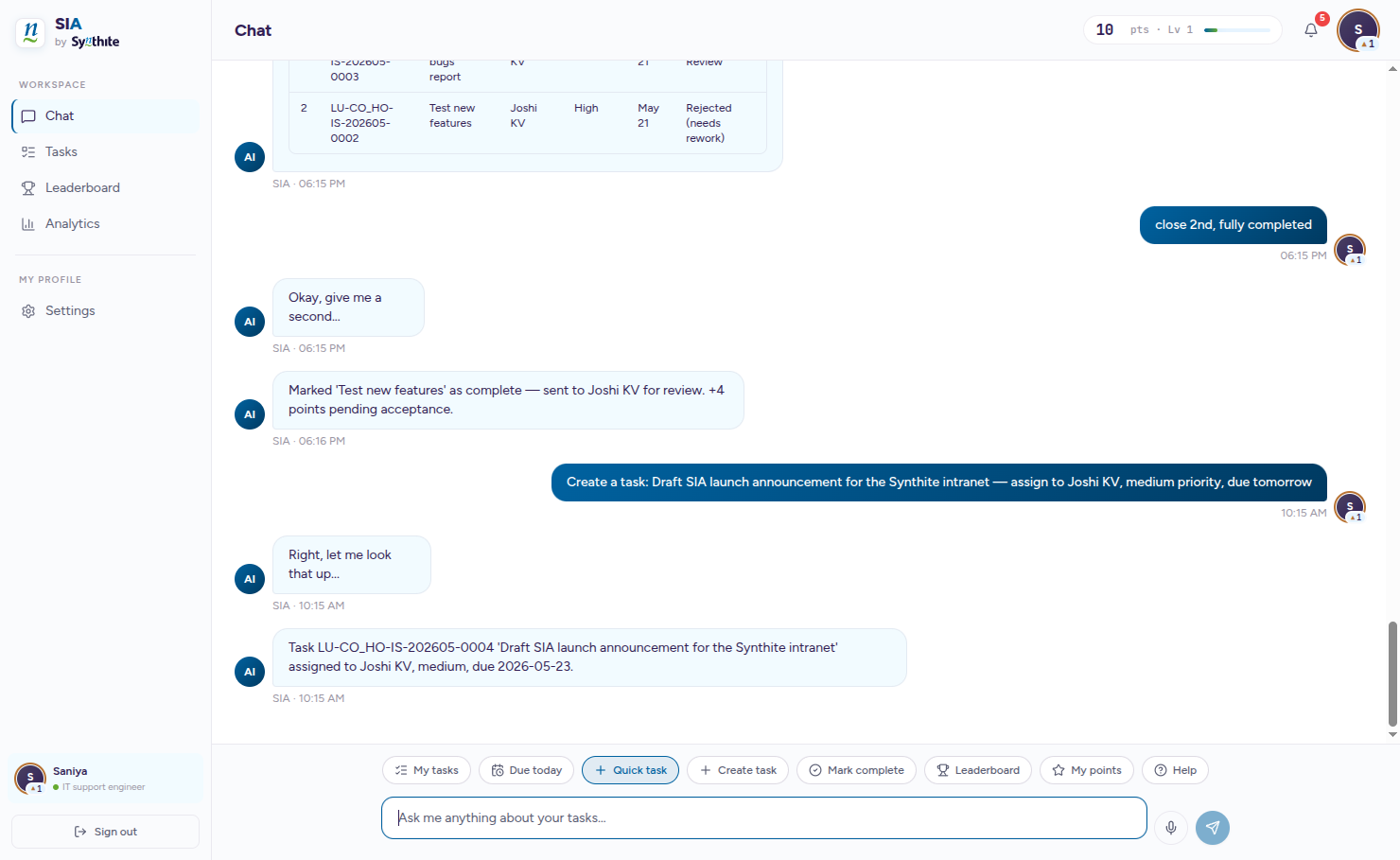
Type the way you would message a colleague, SIA handles the rest.
Built for the way Synthite actually works
Synthite is not one office. It is a network, headquarters, regional hubs, branches, departments, each with its own pace and people. SIA was designed around that reality from day one.
Every branch, its own world
Tasks, points, and leaderboards are all scoped to the branch you belong to. One branch never drowns in another's noise.
Human-readable task IDs
Every task gets an ID like LU-CO_HO-IS-202605-0001, instantly readable and searchable. No more "Task #87412".
Every employee remembered
SIA builds a private memory of how you work, your preferences, your collaborators, the tasks you tend to handle. The longer you use it, the better it fits.
Points, leaderboards, and the quiet motivation of being seen
SIA uses gamification to keep people motivated, every completed task earns points, and points drive the branch leaderboards. There is a reason games are engaging and timesheets are not: games tell you what you did, what it meant, and where you stand; timesheets tell you that you filled in a cell. SIA borrows from the game playbook without turning work into a circus, complete a task, earn points; hit a streak, see it reflected; climb your branch's leaderboard, or just quietly know that what you did mattered.
For managers, it means visibility without surveillance. You see the rhythm of your team, who is carrying weight, who is stuck, who might need a hand, not because you are snooping, but because the system surfaces it naturally.
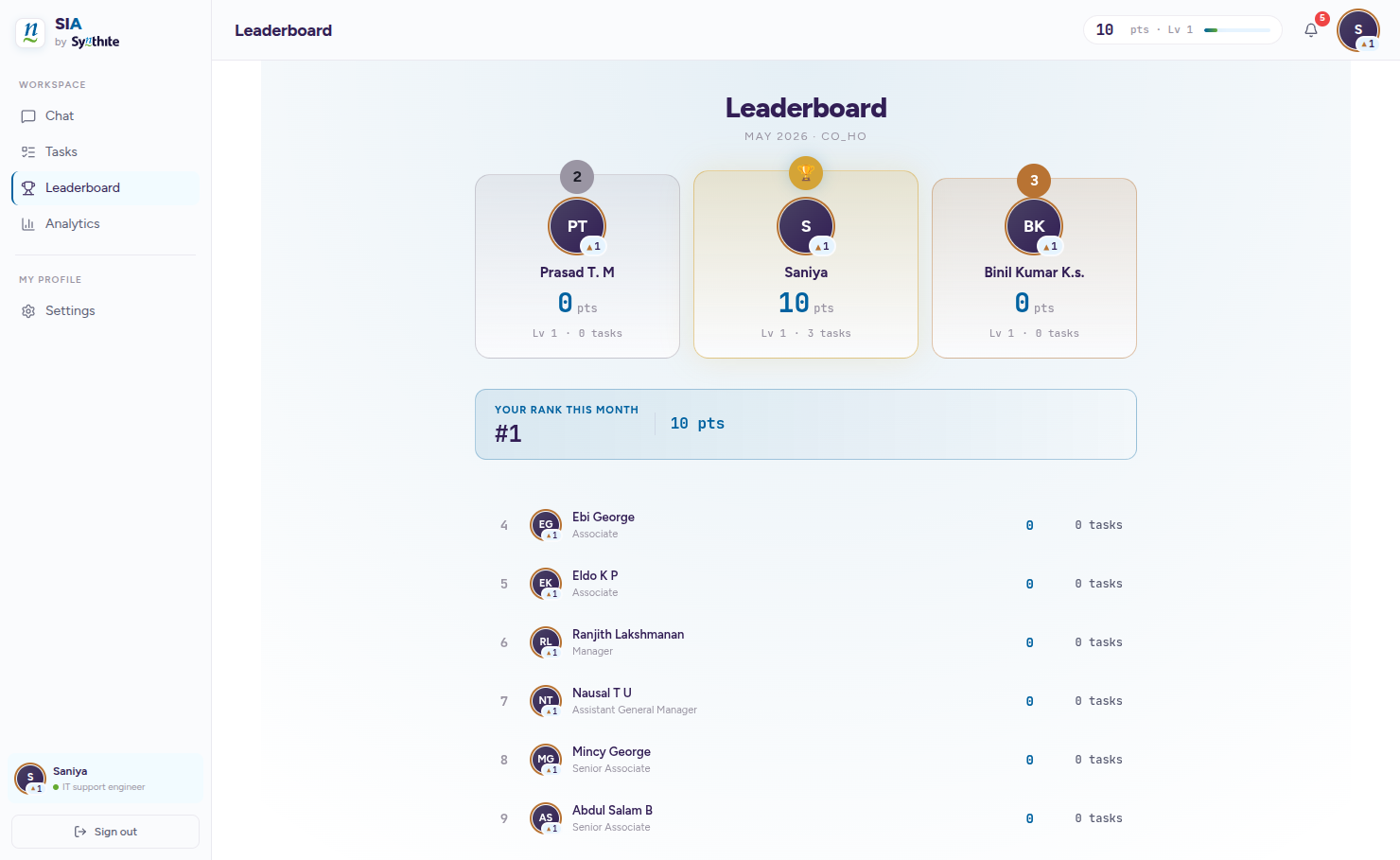
Branch-scoped leaderboards turn quiet effort into visible momentum, every completed task earns points.
A warm welcome for every new joiner
Most software treats new employees like strangers. SIA treats them like guests. When someone joins Synthite, SIA does not dump them into a dashboard, it introduces itself and asks, one question at a time, about their role, the tasks they handle, how they prefer to communicate, and who they work closely with. By the end of that first short conversation, SIA knows enough to be useful, and the new employee feels welcomed rather than processed.
The memory that makes it possible
The reason SIA can hold a real conversation about your work is that nothing it learns is thrown away. Every branch, department, employee, and task is a node in a live knowledge graph that grows as the company moves.
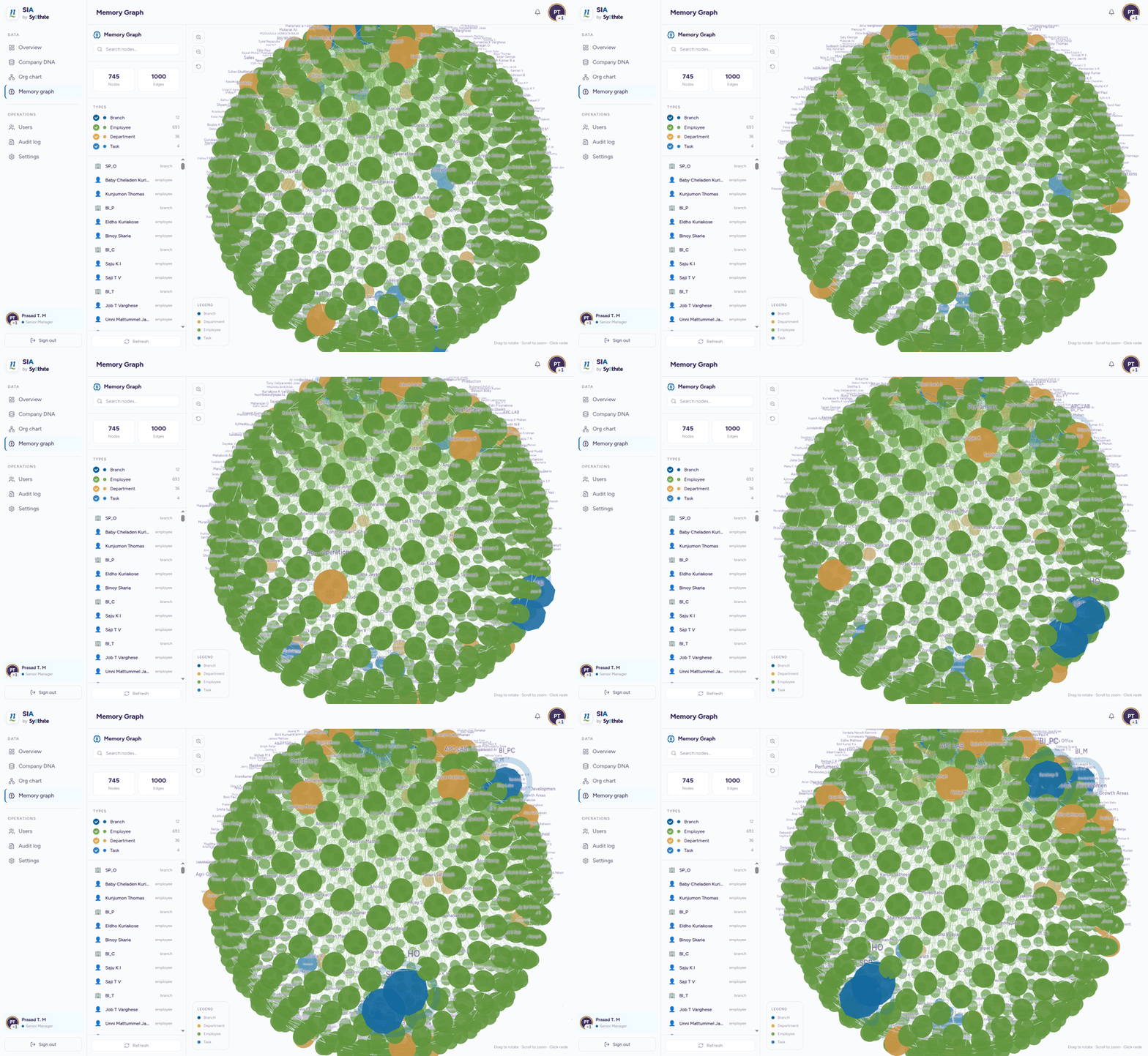
Synthite as a living web, 745 nodes, 1000 edges, one company.
This is not a chart for show, it is how SIA navigates. When you say "ping the Cochin team about the regulator," SIA already knows who the Cochin team is, who works in it, and who owns the regulator topic. The intelligence is not in any single answer; it is in the shape of the network. For leadership, the graph doubles as a sanity check, gaps in the org appear as missing links, and the whole structure of the company becomes something you can look at.
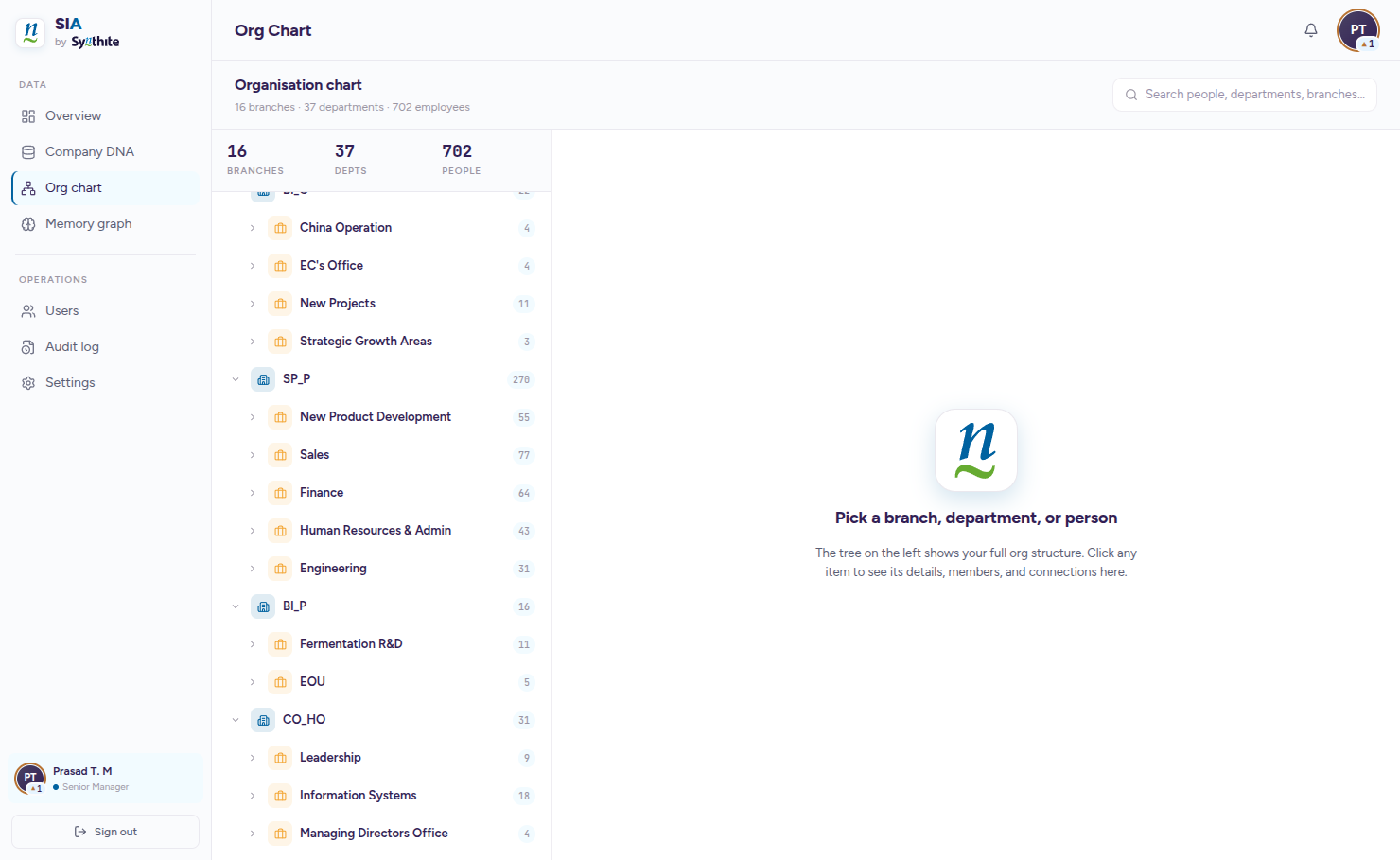
A living map of the entire organisation, branch by branch, department by department.
No more "who do I even ask?"
In a company of 700+ people across 16 branches, the hardest question is often the simplest: who handles this? Before SIA, employees lost real time hunting for the right person, who to ask for a piece of information, who to hand a task to, who actually owns a topic. With that many people across that many branches and departments, it was easy to send work to the wrong desk, or to no desk at all.
SIA removes the guesswork. Because it knows the whole organisation, every person, department, and branch, and what each one is responsible for, it routes information and tasks to the right people automatically. Describe a task and SIA assigns it to whoever genuinely owns that work. Ask a question and it points you to the person who can actually answer. Nobody has to carry the org chart in their head any more.
What admins see
Behind every employee chat is a thin slice of admin: 700+ active employees across 16 branches, recent task activity scrolling by, the Company DNA sync status, and the quick actions that keep the system clean. Admins do not need to babysit SIA, they keep an eye on it and step in when something needs a human.
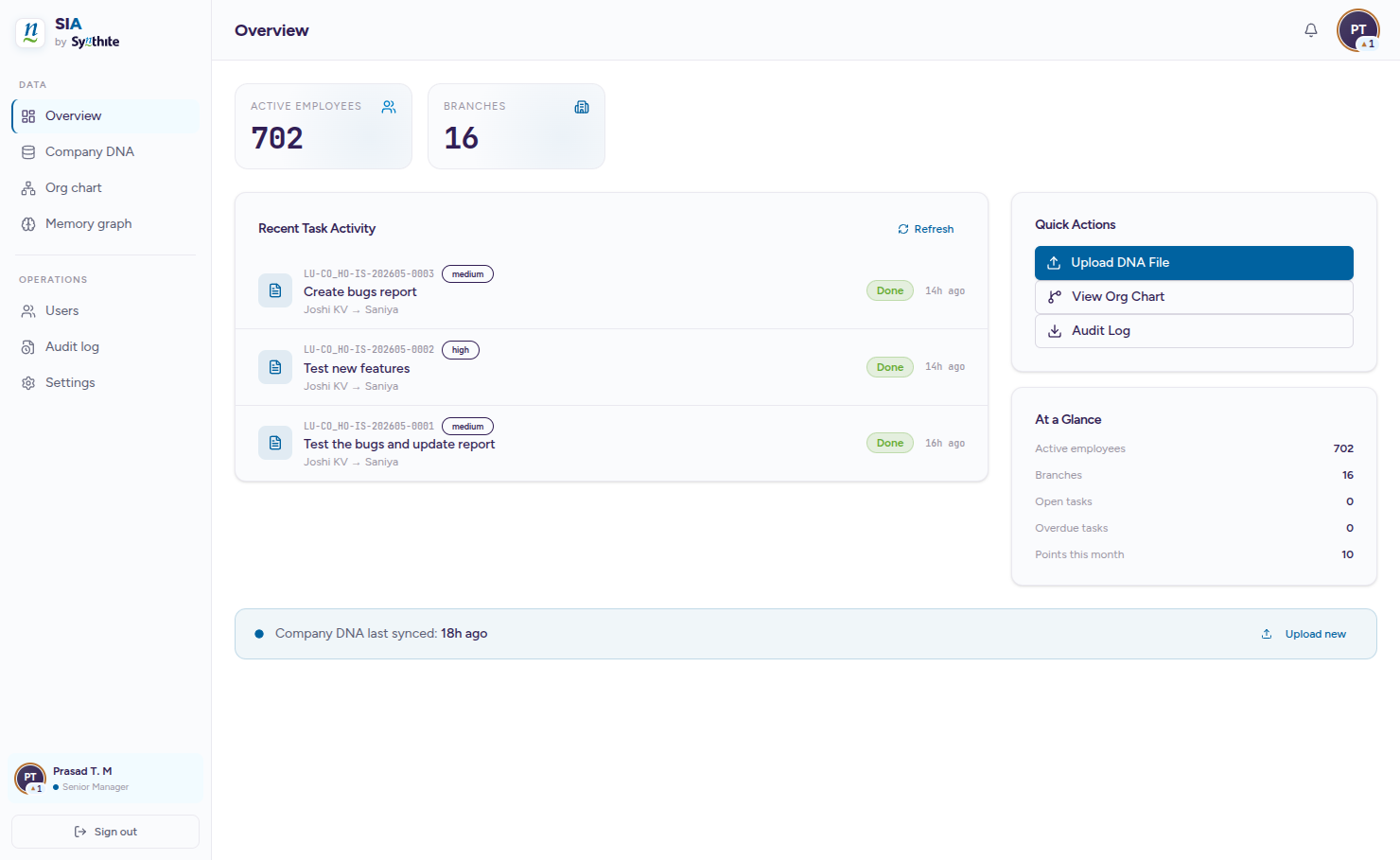
One screen, the whole company at a glance.
Built on Byteflow
SIA's conversational agent, its task engine, the points and leaderboards, the follow-up emails, and the live memory graph all run on Byteflow. Synthite did not build task-management infrastructure from scratch, they defined how SIA should behave and let Byteflow run it across every branch.
What it means for Synthite
- For employees: less admin, more flow, talk about your work, earn points for it, the system handles the paperwork
- For managers: real visibility and rhythm, without nagging anyone for updates
- For leadership: an organisation that updates itself in real time, what is getting done, where, by whom
Frequently asked questions
What is SIA?
SIA, Synthite Intelligent Assistance, is Synthite Industries' internal AI task-management teammate, built on Byteflow. Employees log and manage work by chatting in plain language; SIA logs tasks, awards points, and keeps the whole organisation visible across 16 branches.
How do employees use SIA?
They simply type the way they would message a colleague, describing what they did or what they need. SIA understands, logs the task, updates points and leaderboards, and sends any follow-up emails. No forms, no dropdowns.
What is the memory graph?
It is a live knowledge graph where every branch, department, employee, and task is a node. It is how SIA understands the organisation, so a request like "ping the Cochin team" resolves to the right people automatically.
How does SIA know who to assign a task to?
SIA knows the whole organisation, every person, department, and branch, and what each one handles. When a task is described, it routes it to whoever genuinely owns that work, so employees no longer have to guess who to ask or who to hand a task to among 700+ people.
Does SIA give managers surveillance over staff?
No. SIA gives visibility without surveillance, managers see the rhythm of their team and who might need help, because the system surfaces it naturally, not because anyone is monitoring keystrokes.
How was SIA built?
Synthite built SIA on Byteflow. Rather than building task-management infrastructure from scratch, they defined how the AI teammate should behave and Byteflow runs the conversational agent, the task engine, and the memory graph.
Want an AI teammate like SIA?
Byteflow lets you turn internal operations into a conversation, task tracking, visibility, and team rhythm, without the stale spreadsheets.
Start with Byteflow →Easy automation. For everyone.